Posts

My Planet of the Apes Memoir
Image
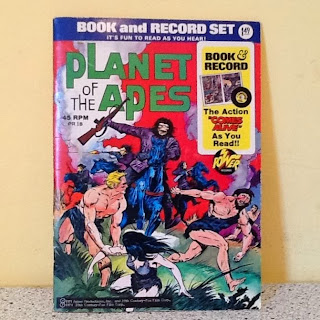
The original Planet of the Apes is a 1963 novel by Pierre Boulle.  I've read it.  It's okay.  I guess Pierre Boulle wrote some other spy novels, and those were pretty good, and he was in love with a married woman, who promised to leave her husband, but ultimately went back to him, and so Pierre Boulle had to go on with a hole in his heart.  But his apes have gone on for fifty years, fascinating us. I always preferred the Planet of the Apes movies to the later sci-fi bonanzas, the Star Wars movies.  The Planet movies weren't exaggerated fairy tales--they were difficult, and dark, and they showed a future that had gotten out of control.  That seemed, I guess, more persuasive to me than the heroic blah-blah-blah of the Star Wars franchise. One time, when I was six, I was at my friend Dane Peterson's house with a couple other kids, and Dane's older brother Paul was putting us through an "astronaut training" cycle in Dane's basement.  We had to run do...

"An Ethos of the Blueness of the Sky": Re-connecting with De Daumier Smith

Image
This week in America, a 19-year-old college quarterback is in the news.  He's a big star, and he's acting irreverently--partying and unabashedly enjoying the spotlight. I laugh, thinking about my own 19-year-old self: a socially awkward college sophomore spending inordinate amounts of time in the library basement, reading all the uncollected Salinger stories in Collier's and Saturday Evening Post on microfiche. It was not a glamorous time.  I felt like Salinger's witty, vulnerable young characters had leapt directly from my own adolescent loneliness onto the page.  When I look back at them now, which I tend to do about once every summer, I sometimes find them a little hyperbolic, or idealized.  But I still feel how much those characters--not so much Holden Caulfield, but more the Glass family, and the characters in the short stories--meant to me as a young adult, and the gratitude I feel toward them quiets my inner pedant. One of the highlights of my 2013 summe...

A Little More Everything

Image
A few weeks ago I wrote a post suggesting that the mathematical concept of zero may interfere with our understanding of the physical world around us.  Because of zero, maybe we believe that there's a  smallest thing--that there's a floor, a hard limit on the low end of sizes, distances, and quantities--when in fact, that may not be true.  Every point of matter--every atom--may contain infinite regress within it.  Or... the concepts of "large" or "small" or "inward" and "outward" may simply not be well-founded. Just after writing that post, I caught Radiolab's "The Trouble with Everything."   In the second half of the episode, Radiolab co-host Robert Krulwich argues with Columbia physicist Brian Greene.  Now that physics suggests that there may be infinite possible universes (there's no reason to think that the big bang happened only once, in one location, i.e., our universe), Krulwich argues, the dream that Physics...

Zilch, Nada, Bupkis

Image
It’s interesting to think about a world where the concept of zero doesn’t exist.   It’s not that farfetched.   Zero seems to have been invented long after other numbers, and doesn’t really arise from any desire to signify existential absence, only mathematical absence.   It looks like zero was invented as a placeholder in mathematical operations.   If you have a number in the tens column but nothing in the ones column, you put a little circle there so the rows stay straight.   Someone thought that up in about 900 CE, apparently.   The Arabic word for it,   صف , signifies “sifre,” or “empty,” like “cypher,” or “chiffre,” meaning “figure,” also the name of the James Bond villain from Casino Royale , which is now my favorite movie character name—“Le Chiffre?”   as in “The Figure?” or “The Empty?”   I mean… that’s brilliant character naming, especially in a movie that involves lots of poker chips.    My point, though, is that ze...

Relationship Saved, At Least Briefly, By Metrical Verse

Image
Her:   Look, I mean, it’s just really hard right now, and it’s obviously not going to get any easier. Him:   You don’t know that.   I mean…. Her:     Don’t interrupt me.    You always interrupt me.   God,  I’ve been putting up with this shit for sixteen weeks. Him:     Sixteen weeks? Her:     116 days. Him:     You counted the days?   That’s messed up. …   Wait.   Are you breaking up with me? Her:     Genius.   Good job on that Ph. D. Him:     Wait.   Just wait.   Hold that thought. Her:     Where are you going? Him:     This’ll take one second. Her:     The tripod?   The camera?   What?   No! Him:     YES!   Listen.   This is only gonna happen once, and I want to remember it.   If this is our last moment together, I want to hold onto it [he sets ...

The New Mona Lisa: Eugene Von Bruenchenhein's "Marie" at Walker Arts Center

Image
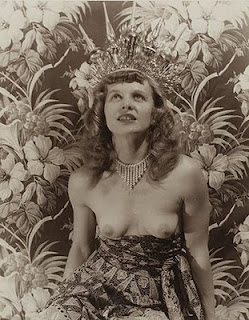
Eugene von Bruenchenhein (1910 - 1983) lived and worked as a baker and a florist in Milwaukee.  By night, he constructed elaborate dreamscapes and fantasy worlds in multiple media.  He painted, sculpted, wrote poetry, and took a remarkable series of photographs of his wife, Evelyn T. "Marie" Kalke.  A room of these photos is currently on exhibit at the Walker Arts Center in Minneapolis, as part of the  "Midnight Party"  exhibit, curated by Joan Rothfuss and focusing on "dreams, fantasies, visions, and meditations." Von Bruenchenhein met Marie at the Wisconsin State Fair in 1939.  Their all-American beginnings led to an all-American pastime: they took dirty pictures together.  Except, as the Walker's exhibition captures, they really aren't dirty pictures.  "A fictive pleasure world" is the language the Walker's description uses.  And the Kinz & Tillou website describes the images as "passionate and provocative, yet playful...
Image
Not every day that you get a piece published with a super cool illustration.  Thanks Katherine Villeneuve, Mark Yakich, and The New Orleans Review .  http://www.neworleansreview.org/the-pajama-queen-and-the-in-law-terloper/ "(Now, steak sauce: that’s tangy, and we put it on cooked slices of cow or deer or cooked eggs from chickens or ducks or soy products or tofu, if we’re vegetarian.  If we’re vegan, we might avoid steak sauce because it has a meat word in its name (also, some people will give steak sauce a chance on almost anything, like on ice cream or in coffee or on a banana.  It can be good.))."